
Site Reliability Engineering Services That Keep Live Cloud Environments Trustworthy
Once workloads are running in production, reliability stops being a migration checklist item and becomes an ongoing discipline. Mirketa's site reliability engineering services give already-live AWS, Azure, and Google Cloud environments unified observability, defined SLOs and error budgets, a real on-call and incident response model, and continuous security monitoring, so 'reliable' is a number your team can point to, not a feeling.
- 99.95% Median Uptime SLO
- 24/7 On-Call Coverage
- Sub-15-Minute MTTA
- Security Monitoring Included
Reliability Operations Center
LIVE- Resolved
Checkout API latency spike
- Healthy
Error budget: payments service
- Investigating
Anomalous auth traffic: region us-east
Trusted by SRE and Platform Engineering Teams


Business Challenges
Why 'It's in the Cloud' Doesn't Mean 'It's Reliable'
Most teams we meet aren't struggling to run workloads in the cloud. They're struggling to know, with confidence, whether those workloads are actually healthy. These four problems show up again and again once the migration excitement fades and steady-state operations begin.
Alerts Firing With No Clear Owner
Dashboards and alert rules were bolted on ad hoc, so when something pages at 2 a.m., three teams assume someone else has it, and nobody actually does.
No Defined SLOs, So 'Reliable' Is Subjective
Without agreed-upon service level objectives and error budgets, every outage debate becomes an argument about whether it even counted as one.
Incidents That Take Hours to Diagnose
Metrics live in one tool, logs in another, and traces nowhere at all, so root cause analysis means stitching together screenshots across five browser tabs.
Security Monitoring Bolted On as an Afterthought
Cloud security monitoring was added after the fact with generic rules, producing alert fatigue instead of catching the anomalous access pattern that actually matters.
Cloud Solution Overview
Reliability as an Operating Discipline, Not a One-Time Project
Mirketa's site reliability engineering services start from a simple premise: your workloads are already live, so the first job is to make their actual health visible. We instrument metrics, logs, and traces into a single observability stack, define the service level indicators that matter for each critical user journey, and turn those SLIs into SLOs with a real error budget: a number engineering and the business can both agree on.
From there, reliability becomes operational, not aspirational. We build the on-call rotation, the escalation paths, and the runbooks so that when something breaks, the right person is paged with the right context in minutes, not hours. Every incident closes with a blameless postmortem that feeds back into monitoring coverage and automated remediation, so the same failure mode doesn't page anyone twice.
Security monitoring is woven into the same observability layer rather than living in a separate silo: anomalous access patterns, privilege escalation attempts, and configuration drift get surfaced through the same pipeline your SRE team already watches, evaluated against the same on-call process. Chaos engineering and resilience testing are introduced gradually and safely, in staging first and then in controlled production experiments, so you find the weak points on your terms instead of during an actual outage.
Core Services
Six Ways Mirketa Delivers SRE and Security Monitoring
Every site reliability engineering services engagement draws from these six service lines, scoped to the maturity of your current environment.
Observability & Monitoring Setup
Unified metrics, logs, and distributed tracing so engineers can answer 'what's actually happening right now' in one place, not five.
Incident Response & On-Call Management
A staffed on-call rotation, escalation policy, and paging workflow built around your team's actual coverage hours and skill mix.
SLO & Error Budget Definition
Service level indicators tied to real user journeys, translated into SLOs and error budgets that both engineering and leadership can act on.
Chaos Engineering & Resilience Testing
Controlled fault-injection experiments that surface single points of failure before customers do, staged from non-production to live traffic.
Cloud Security Monitoring
Continuous threat detection across identity, network, and workload layers, correlated with the same observability data your SRE team uses.
Automated Remediation & Runbooks
Codified runbooks and auto-remediation scripts that resolve known failure signatures without waking a human up for the third time this month.
Key Features
What a Properly Run SRE Practice Actually Includes
These are the capability areas every Mirketa SRE services engagement is built around, from first alert to full remediation.
Unified Observability Stack
Metrics, logs, and traces correlated in one pane of glass instead of scattered across disconnected tools.
SLI-Driven Alerting
Alerts tied to service level indicators that reflect user impact, not noisy infrastructure thresholds nobody trusts.
On-Call Rotation & Escalation Policy
A documented rotation with clear escalation paths, so ownership is never ambiguous when a page fires.
Living Runbooks
Step-by-step incident runbooks that are tested, versioned, and updated after every postmortem, not written once and forgotten.
Blameless Postmortems
A structured review process focused on system and process gaps, not individual blame, that actually changes what happens next time.
Security & Reliability Correlation
Anomaly detection and access monitoring surfaced through the same observability pipeline your on-call engineers already watch.
Incident Lifecycle
Anomaly Detected
Alert Triaged
On-Call Paged
Root Cause ID'd
Remediated & Documented
Benefits
What Changes Once Reliability Has an Owner
These are the outcomes Mirketa's site reliability engineering clients consistently report within the first two quarters.
Incidents Resolved in Minutes, Not Hours
Unified observability and tested runbooks turn root cause analysis from a scavenger hunt into a documented procedure.
A Shared, Defensible Definition of 'Reliable'
SLOs and error budgets give engineering and the business the same number to plan releases and risk tolerance against.
On-Call That Doesn't Burn Out Your Team
Clear escalation paths and automated remediation mean fewer 2 a.m. pages for problems the system can fix itself.
Threats Caught Alongside Outages
Security monitoring built into the same pipeline means anomalous behavior gets the same fast response as a service degradation.
Migration / Implementation Process
A Five-Stage Path to Steady-State Reliability
A structured onboarding methodology refined across SRE and security monitoring engagements for teams whose workloads are already live in the cloud.
Incident Escalation Network
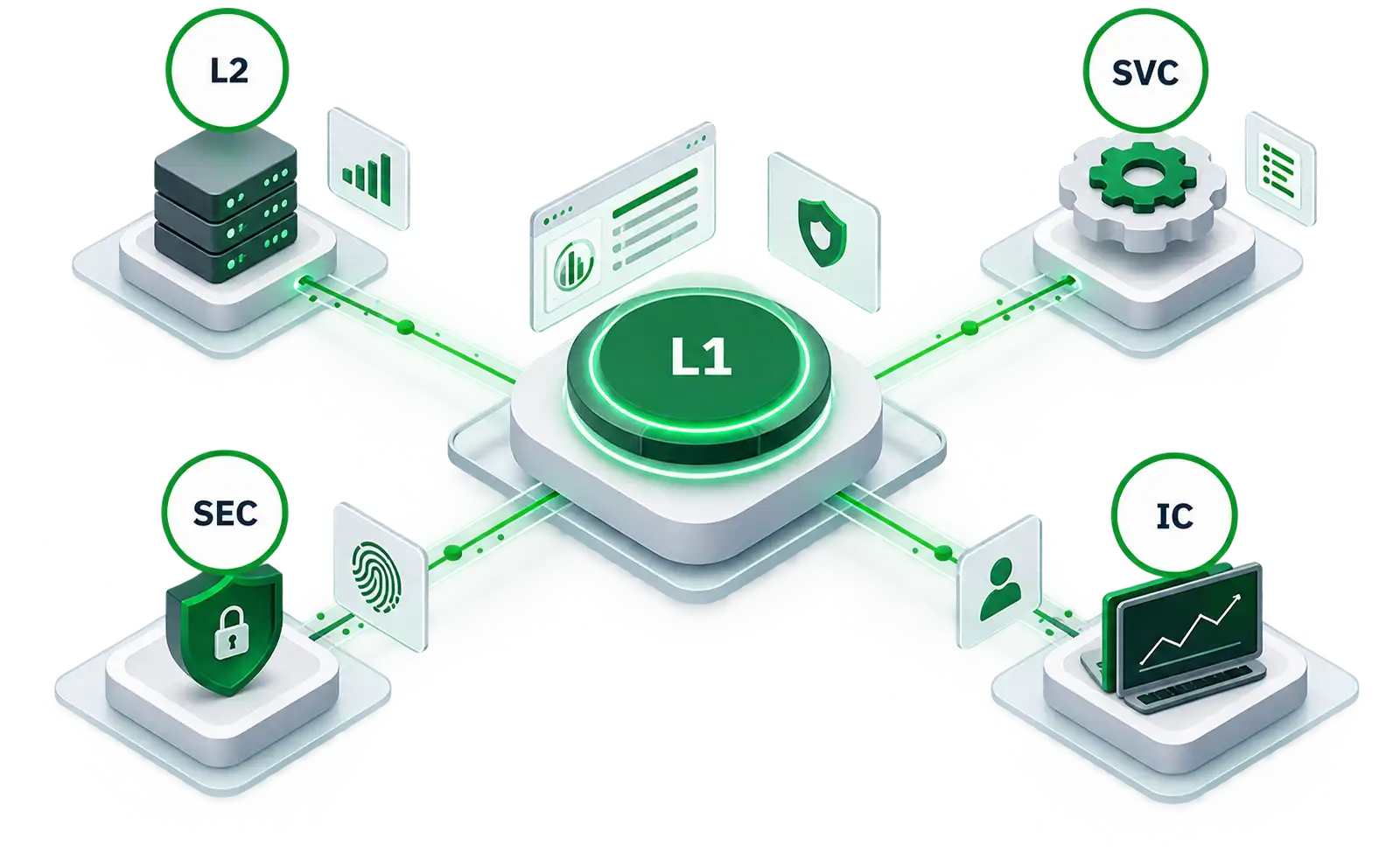
- On-Call Engineer (Primary)
- Secondary On-Call
- Service Owner
- Security On-Call
- Incident Commander
Observability Baseline Assessment
We audit your existing metrics, logs, tracing, and alerting to find blind spots before adding a single new dashboard.
Instrumentation & Dashboard Setup
Metrics, logs, and traces are unified into a single observability stack scoped to your critical user journeys first.
SLO Definition Workshop
Engineering and business stakeholders agree on SLIs, SLOs, and error budgets together, so nobody discovers the target during an outage.
On-Call Runbook Development
Escalation policies and step-by-step runbooks are written, tested, and staffed before your team takes its first live on-call shift.
Steady-State Operations
Ongoing on-call coverage, chaos engineering cadence, and quarterly SLO reviews keep reliability improving instead of quietly decaying.
Technologies Supported
Observability and Operations Tooling We Work In
Our SRE and security monitoring engagements plug into the tools your team already runs, or help you choose the right stack from scratch.
Prometheus & Grafana
Datadog
PagerDuty
OpenTelemetry
AWS CloudWatch
Kubernetes
Why Mirketa
A Reliability Partner That Measures Instead of Guessing
Plenty of partners can set up a dashboard. Fewer can define an error budget your leadership will actually trust and staff the on-call model behind it.
SLO-First Engagements
Every engagement starts by defining what reliable actually means for your critical services, in numbers both sides agree on.
Real On-Call Staffing, Not Just Tooling
We help build and, when needed, augment the on-call rotation itself, not just hand over a PagerDuty license.
Security Woven Into Reliability
Threat detection runs through the same observability pipeline as uptime monitoring, so nothing falls in the gap between teams.
Chaos Engineering Done Safely
Fault injection is introduced gradually, starting in staging, with clear blast-radius controls before touching live traffic.
Fast, Measurable MTTA and MTTR
Sub-15-minute mean time to acknowledge and steadily improving mean time to resolution, tracked and reported every month.
Support That Outlasts the Handoff
We stay engaged through steady-state operations, not just the initial instrumentation sprint.
FAQ
Frequently Asked Questions About Site Reliability Engineering Services
An SLO (service level objective) is a target for a service level indicator, like 99.95% of checkout requests succeeding in under 400ms. The error budget is the allowed room to miss that target. Together they turn 'reliable' from a feeling into a number both engineering and the business can plan against.
We help design a rotation that matches your team's real coverage hours: whether that's a follow-the-sun model, a primary/secondary structure, or Mirketa engineers augmenting your existing on-call bench during ramp-up or off-hours.
Response time commitments are scoped per severity tier in the engagement agreement. Our typical benchmark across active clients is a sub-15-minute mean time to acknowledge for page-worthy incidents, with resolution targets set per service based on its SLO.
We start in staging with clearly scoped experiments and a defined blast radius, validate the system's response, and only graduate to controlled production experiments once the failure mode is well understood and rollback is proven.
Monitoring tells you a threshold was crossed. Observability lets you ask new questions about system behavior you didn't anticipate when you set up the dashboard, which is what actually shortens root cause analysis during a real incident.
We correlate security signals with the same infrastructure and application telemetry your SRE team already watches, so an anomalous access pattern is investigated with the same urgency and context as a service degradation, not routed to a disconnected team.
Most engagements run on a monthly retainer scoped to the number of services under SLO and the on-call coverage model required, with a fixed-scope onboarding phase billed separately from steady-state operations.
Yes. Most engagements augment an existing team rather than replace it: we typically own observability architecture, SLO governance, and specific on-call shifts while your engineers retain deep product knowledge.
Get Started
Get an SRE Readiness Review
Tell us about your current monitoring setup, on-call model, and biggest reliability pain point. A site reliability engineer will follow up within one business day.
- A specialist follows up within one business day
- A no-obligation conversation about your specific goals
- Answers from someone who actually works in this space
- Your information stays confidential