Whether you are redesigning Salesforce CPQ or starting greenfield, Mirketa combines Revenue Management expertise with ARIA-enabled delivery to accelerate the product, pricing and configuration work that slows implementations down.
Human-governedReview, validate and deploy through controlled Salesforce processes
ARIA in action
What ARIA actually changes in the implementation.
Traditional implementations spend significant time reading spreadsheets, interpreting product and pricing rules, translating them into Salesforce structures, checking dependencies and rebuilding the same patterns manually. ARIA turns that translation work into a repeatable, reviewable delivery workflow.
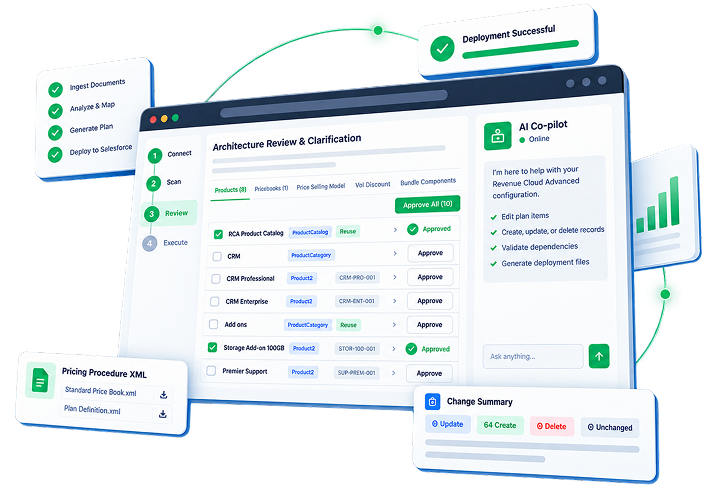
Document-to-configuration workflow
Give ARIA the revenue model you have. Get a structured ARM model your consultants can review.
ARIA does more than extract fields. It interprets source artifacts, identifies Revenue Management entities and relationships, constructs target configuration starting points, surfaces gaps, and packages approved outputs for controlled deployment.
INGESTRead structured and unstructured source content
UNDERSTANDIdentify entities, rules, relationships and intent
CONSTRUCTCreate target ARM configuration starting points
VALIDATEFlag missing mappings, dependencies and conflicts
PACKAGEPrepare approved configuration for deployment
Product ConfiguratorBundles, options, product relationships and configuration constraints
Salesforce PricingPricing Procedures, Pricing Elements and Decision Table logic
Review PackageGaps, validation issues, traceable decisions and deployment-ready outputs
Key distinction: ARIA is not a document summarizer. The value is in translating revenue logic into the structures an Agentforce Revenue Management implementation actually needs.
01 · DOCUMENT INTELLIGENCE
Understand messy source material
Interpret product catalogs, pricing sheets, contracts, requirements and legacy configuration artifacts instead of relying on repeated manual transcription.
Useful for catalog discovery, migration assessment and greenfield requirements.02 · REVENUE MODEL CONSTRUCTION
Build the target model
Translate source concepts into Product Catalog Management, Product Selling Models, Price Books, bundles and related ARM configuration structures.
The target model is designed for ARM—not blindly copied from CPQ.03 · GUIDED PRICING
Turn pricing logic into structured setup
Guide consultants through Pricing Procedures, pricing elements, Decision Tables, discounts and adjustment patterns using contextual inputs.
Salesforce Pricing itself depends on products, selling models, price books and decision tables being correctly established first.04 · VALIDATION ENGINE
Catch gaps before they become rework
Surface missing fields, inconsistent mappings, dependencies and rule conflicts while the foundation is still reviewable.
Validation stays paired with consultant and business review.05 · HUMAN-IN-THE-LOOP REVIEW
Let consultants make the decisions
ARIA accelerates repetitive analysis and setup; Mirketa consultants refine architecture, resolve ambiguity and validate business intent.
AI speeds the work without removing accountability.06 · CONTROLLED DEPLOYMENT
Move approved configuration through Salesforce controls
Package approved changes for standard deployment processes with traceable review and implementation governance.
No black-box autonomous production changes.
Two paths to Agentforce Revenue Management
Whether you are redesigning an existing Salesforce CPQ environment or building Revenue Management from the ground up, Mirketa gives you a focused starting point based on where you are today—while both paths lead into the same ARIA-enabled implementation model.
Existing Salesforce CPQ / legacy CPQ
Revenue Management FastTrack
“How do we move without reproducing years of CPQ complexity in the new architecture?”
Profile products, bundles, price books, pricing rules and customizations
Identify what should be retained, rationalized, redesigned or retired
Construct the target Product + Pricing foundation in ARM
Prove one representative domain before broader rollout
Start with the path that matches your Revenue Management journey.
Whether you are moving from Salesforce CPQ or building Agentforce Revenue Management from the ground up, choose a focused starting point to assess, prove, and scale your implementation with confidence.
FastTrack — for Salesforce CPQ transformation
Modernize your existing CPQ model without carrying unnecessary legacy complexity into Agentforce Revenue Management.
Assess
2 weeks
Understand what should move, change, or be redesigned.
Product and pricing landscape review
CPQ rules, customizations, and dependencies
Target Revenue Management architecture
Recommended migration approach
MOST POPULAR
Prove
4–6 weeks
Validate the redesigned foundation on a real revenue motion.
One representative product family or business motion
Product Catalog, bundles, and selling models
Price Books, Pricing Procedures, and discounts
Real pricing and exception scenarios
Accelerate
6–8 weeks
Expand the proven design into a broader implementation foundation.
Additional product domains or markets
Expanded catalog and pricing setup
Common configuration standards
Roadmap into quoting, contracts, orders, billing, and integrations
LaunchFast — for greenfield Revenue Management
Design the product, pricing, and commercial model correctly from the start, then prove it before scaling.
Blueprint
2 weeks
Turn your commercial model into a scalable Revenue Management design.
Product hierarchy and classifications
Selling models and bundle patterns
Pricing and discount architecture
Key dependencies and rollout approach
MOST POPULAR
Prove
4–6 weeks
Validate the design in Salesforce on a representative revenue motion.
One representative product family
Product Catalog, bundles, and selling models
Price Books, Pricing Procedures, and discounts
Real pricing, exception, and boundary scenarios
Launch
6–8 weeks
Extend the proven design into the broader implementation foundation.
Additional product domains or markets
Expanded catalog and pricing model
Reusable configuration patterns
Roadmap into quoting, contracts, orders, billing, and integrations
Beyond the foundation
Prove the foundation first. Carry it through the full Revenue Management journey.
ARIA creates velocity where the program starts, while the Mirketa engagement continues through the downstream capabilities required for a complete Revenue Management transformation.
QuoteTransaction design, approvals and seller experience
Contract & OrderCLM, order capture and downstream orchestration
Assets & ChangeAmendments, renewals and lifecycle processes
Bill & IntegrateBilling, invoicing, tax, ERP and payment integration
Why this matters: the first two stages establish the product and pricing model that downstream Revenue Management processes depend on. Getting them right early reduces later redesign.
FAQ
Questions buyers ask about ARIA and Agentforce Revenue Management.
ARIA ingests business documents such as product catalogs, pricing sheets, contracts and requirements; identifies Revenue Management entities, rules and relationships; constructs reviewable configuration starting points for supported areas such as Product Catalog, Price Books, Bundle Configuration and Pricing Procedures; flags validation issues; and packages approved outputs for controlled Salesforce deployment processes.
No. For migration, ARIA helps interpret legacy CPQ and source artifacts, but the goal is to construct the target Revenue Management model rather than copy the old one. For greenfield programs, the same engine works from product, pricing and requirements documentation without a legacy CPQ source.
No. ARIA accelerates repetitive analysis and configuration-heavy work. Architecture, business design, ambiguity resolution, exception handling, integration design, testing, UAT and deployment governance remain consultant- and customer-led.
Because downstream quoting, product configuration, contracts, orders and billing depend on having a coherent product and pricing foundation. Salesforce Pricing also requires foundational setup such as products, Product Selling Models, Price Books and Decision Tables before Pricing Procedures can work correctly.
The proof is selected based on representative complexity rather than a token SKU sample. A typical envelope may include hundreds of sellable SKUs, but final scope depends more on bundles, attributes, selling models, pricing procedures, adjustment patterns, data quality and dependencies than raw product count.
See ARIA on your revenue model
Bring us the artifacts your implementation team is already wrestling with.
Share one representative product catalog, pricing workbook, bundle specification, CPQ extract or business requirement. We will identify the right FastTrack or LaunchFast path and show where ARIA can create delivery leverage.
 Certified Partner
 SOC 2 Certified
 HIPAA Ready
 Enterprise Ready