Build a Governed AI Roadmap That Moves from Strategy to Scale
From Scattered AI Pilots to a Sequenced, Accountable Program
Most enterprises run AI as a series of disconnected pilots with no shared prioritization logic and no consistent oversight. AI roadmap governance replaces that pattern with a structured plan: one that sequences use cases by business value and feasibility, assigns clear ownership, and puts data, security, and responsible-AI controls in place before initiatives reach production.
AI Initiatives Without Governance Rarely Scale
AI programs tend to start as isolated experiments, a chatbot pilot here, a forecasting model there, each sponsored by a different team, evaluated against different criteria, and rarely connected to a shared business case. Without a roadmap, that pattern is difficult to break: leadership loses visibility into which initiatives are working, budget gets allocated to whichever proposal is loudest rather than most valuable, and there is no consistent way to manage the security, compliance, and operational risk each initiative introduces.
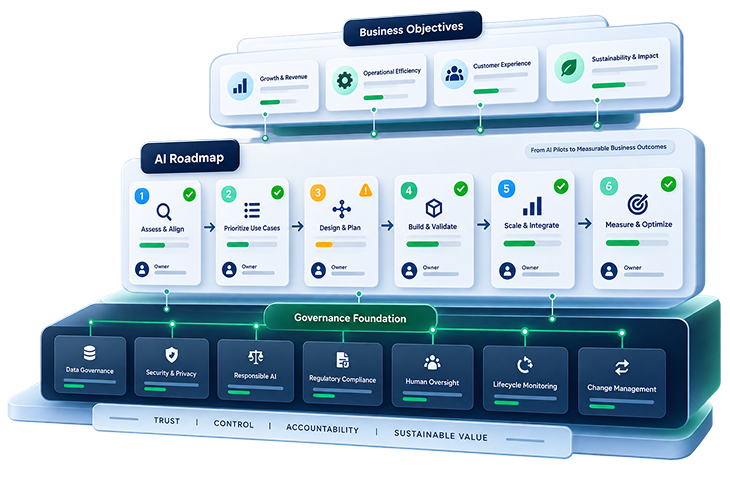
AI roadmap governance establishes the decision rights, controls, ownership, and monitoring required to move AI initiatives from experimentation into production. It gives leadership a single, business-aligned plan for what gets built, in what order, under what oversight, and how success is measured.
Strategic Alignment
Prioritize AI initiatives against the business outcomes they are meant to support, not against which team asks first.
Governance & Risk
Establish controls across data, security, compliance, and responsible AI before initiatives move into production.
Prioritization
Evaluate AI opportunities on value, feasibility, and data readiness so effort goes where it will actually pay off.
Execution Roadmap
Turn strategy and priorities into a sequenced, resourced plan with clear ownership at every stage.
A Roadmap Built in Seven Stages
Assess
Evaluate current AI maturity across business, data, technology, security, governance, talent, and operating model.
Outcome: A documented readiness baselineAlign
Connect potential AI initiatives to specific business objectives and executive sponsors.
Outcome: Confirmed executive sponsorshipPrioritize
Score candidate use cases on business value, feasibility, data availability, and risk.
Outcome: A ranked, defensible use-case listGovern
Define decision rights, controls, and policies for data, security, privacy, and responsible AI.
Outcome: An approved governance frameworkExecute
Deliver initiatives in sequence, starting with pilots and scaling what proves out.
Outcome: Production-ready AI initiativesMeasure
Track initiatives against the KPIs and success criteria defined during alignment.
Outcome: Objective evidence of business impactOptimize
Revisit priorities, retire what isn't working, and reallocate capacity to what is.
Outcome: A roadmap that stays current
Seven Dimensions of AI Readiness
A roadmap is only as good as the assessment it's built on. Each of these dimensions surfaces gaps that, left unaddressed, tend to stall AI initiatives after they've already consumed budget and attention.

Business Readiness
Whether AI initiatives map to specific business objectives with defined ownership and executive sponsorship.

Data Readiness
The quality, completeness, and accessibility of the data each initiative depends on.

Technology Readiness
Whether your cloud, integration, and application architecture can support the initiatives you're planning.

Security Readiness
Whether access controls, data protection, and monitoring are in place before AI touches production data.

Governance Readiness
Whether decision rights, policies, and oversight structures exist to approve and monitor AI initiatives.

Talent Readiness
Whether the skills and cross-functional literacy needed to build, run, and govern AI initiatives are in place.

Operating Model Readiness
Whether workflows, ownership, and change management practices can absorb AI-driven changes to how work gets done.
Decide What Moves First
Not every AI opportunity deserves the same attention. Candidate use cases are evaluated against business value, technical feasibility, data availability, implementation complexity, risk, regulatory impact, time to value, and strategic alignment, then plotted against value and complexity to decide sequencing.
- Business Value
- Technical Feasibility
- Data Availability
- Implementation Complexity
- Risk
- Regulatory Impact
- Time to Value
- Strategic Alignment
Prioritize First
Clear business impact with a manageable path to production: the initiatives that should anchor an early roadmap.
Strategic Roadmap
Meaningful impact that requires sustained investment: sequence these deliberately rather than rushing them.
Opportunistic
Worth doing when capacity allows, but shouldn't compete with higher-value work for resources.
Deprioritize
Limited business case relative to the effort required: revisit only if the underlying conditions change.
Governance Is Continuous, Not a Sign-Off
A one-time approval at project kickoff doesn't hold up once an AI initiative reaches production. Mirketa's governance model treats oversight as an ongoing responsibility spanning strategy through operations.
Strategy & Alignment
Keeping the roadmap connected to current business priorities as they shift.
Data Governance
Ownership, quality standards, and access policies for the data AI initiatives depend on.
Security & Privacy
Access controls, data protection, and privacy-by-design requirements for every initiative.
Responsible AI
Fairness, transparency, and explainability standards applied consistently across initiatives.
Regulatory Compliance
Alignment with the regulatory requirements relevant to your industry and geography.
Model Lifecycle
Version control, retraining triggers, and retirement criteria for every model in production.
Human Oversight
Defined points where a person reviews or can override an AI-driven decision.
Monitoring & Performance
Ongoing tracking of accuracy, drift, and business impact after go-live.
Change Management
Communication, training, and adoption support as AI changes how teams work.
Six Phases, From Assessment to Continuous Optimization
- Phase 1
AI Strategy & Assessment
Establish where the organization stands and what it's trying to achieve.
Key Activities
- Stakeholder interviews across business and IT
- Readiness assessment across all seven dimensions
- Definition of target business outcomes
Outcome: A documented baseline and set of guiding objectives.
- Phase 2
Use-Case Discovery & Prioritization
Build a ranked, defensible list of AI opportunities.
Key Activities
- Workshops to surface candidate use cases
- Scoring against value, feasibility, and risk
- Sequencing into an initial roadmap draft
Outcome: A prioritized use-case backlog.
- Phase 3
Governance Framework
Put decision rights and controls in place before execution begins.
Key Activities
- Define governance structure and decision rights
- Establish data, security, and responsible-AI policies
- Assign accountable owners per initiative
Outcome: An approved governance framework ready to apply.
- Phase 4
Pilot & Validation
Prove out the highest-priority use cases at limited scale.
Key Activities
- Scope and deliver pilots for top-ranked use cases
- Validate assumptions on data, integration, and value
- Apply governance controls from day one
Outcome: Evidence-based go/no-go decisions for scaling.
- Phase 5
Production Scaling
Move validated initiatives into production and to additional teams or geographies.
Key Activities
- Harden pilots for production reliability and scale
- Extend governance monitoring to live initiatives
- Expand successful pilots to additional business units
Outcome: AI initiatives operating at production scale under governance.
- Phase 6
Continuous Optimization
Keep the roadmap current as priorities and results change.
Key Activities
- Review performance against defined KPIs
- Reprioritize based on new opportunities or constraints
- Retire or retool initiatives that underperform
Outcome: A roadmap that adapts rather than goes stale.
What a Governed Roadmap Delivers
Budget and attention go to the initiatives most likely to deliver business value.
Security, compliance, and responsible-AI considerations are addressed before, not after, go-live.
A clear governance framework removes the ambiguity that stalls initiatives after a successful pilot.
Every initiative has an accountable owner, not a diffuse group of interested stakeholders.
Business, IT, data, and security teams work from the same prioritized plan.
Oversight structures that hold up as more initiatives move into production.
KPIs defined at the start make it possible to evaluate results objectively.
A roadmap and governance framework that keep working as the AI portfolio grows.
An Experienced Partner for AI Roadmap Governance
Enterprise Transformation Experience
Over a decade delivering digital transformation, CRM, ERP, and cloud initiatives for enterprise clients.
Salesforce AppExchange Partner Since 2013
Certified expertise across the Salesforce ecosystem, including Salesforce Einstein and Agentforce.
AI Consulting and Implementation, End to End
From readiness assessment and roadmap design through agent development and production support.
Data Foundations Expertise
Experience unifying and preparing data across CRM, ERP, and legacy systems: the foundation most AI initiatives depend on.
Governance-Minded Delivery
Security, compliance, and responsible-AI considerations built into how initiatives are scoped, not added on afterward.
Enterprise Integration Capability
Experience connecting AI initiatives into existing systems rather than standing them up in isolation.
Frequently Asked Questions
AI roadmap governance is the combination of a sequenced implementation plan and the decision rights, controls, and monitoring needed to move AI initiatives from experimentation into production responsibly.
Without a roadmap, AI initiatives tend to run as disconnected pilots with no shared prioritization logic. A roadmap gives leadership a single, sequenced plan for what gets built, in what order, and why.
Candidate use cases are scored against business value, technical feasibility, data availability, implementation complexity, risk, regulatory impact, time to value, and strategic alignment, then sequenced accordingly.
At minimum: decision rights and ownership, data and security controls, responsible-AI standards, regulatory compliance requirements, model lifecycle management, human oversight points, and ongoing performance monitoring.
Each candidate initiative is connected to a specific business objective and an accountable executive sponsor before it's added to the roadmap. Initiatives without a clear business case don't move forward.
Roadmaps should be reviewed on a regular cadence, typically quarterly, and whenever a major shift in business priorities, regulation, or results warrants reprioritization.
By addressing data quality, security, compliance, and responsible-AI requirements before an initiative reaches production, rather than discovering gaps after it's already been deployed.
Turn Your AI Strategy Into a Governed Roadmap
Get a structured, business-aligned plan for what to build, in what order, and under what governance, before you commit further budget to AI.
Get Started
Schedule an AI Roadmap Consultation
Tell us about your AI initiatives and goals, and one of our AI strategists will follow up within one business day.
- No-obligation discovery call
- Guidance scoped to your industry and current AI maturity
- Response within one business day
 Certified Partner
 SOC 2 Certified
 HIPAA Ready
 Enterprise Ready