
Agentic AI Security: Tool Poisoning and Audit Trails
Explore agentic AI security risks, including MCP tool poisoning, and learn how governance, permissions, approvals, and audit trails reduce exposure.
n the world of JavaScript there is a function called operator that can simplify your code, make it easier and more interesting. Whether you’re working with arrays, objects, or arguments, the operator can empower you by providing a simple and convenient way to manipulate and combine data. In this blog, we will take a deeper dive into the spread operator and explore its many uses and benefits.
Basics of the Spread Operator:
The spread operator, represented by three consecutives (…), allows you to expand the contents of an object (such as an array or string) or copy the object from one product to another. It makes your code more readable and efficient by providing short instructions for working with data collection.
Spreading Arrays:
One of the most common uses of the operator is to manipulate strings. Using the spread operator, you can easily make superficial copies of arrays, merge arrays, and remove individual elements.
Combining Objects:
Another strength of the operator is the ability to combine items. You can easily create new objects by combining objects from various objects without copying objects or using external libraries.
Cloning Objects and Immutable Updates:
When dealing with objects in JavaScript, variables should generally be avoided to avoid side effects. The spread operator makes it easy to complete the transformation by providing a simple way to create a shallow image of an object.
Spreading Function Arguments:
In addition to arrays and objects, the span operator can also be used with parameters. It allows you to pass arrays or arrays to functions as separate arguments, which is especially useful when dealing with mutable functions or wanting to have a business conflict.
Performance Considerations:
While the spread operator has many advantages, it is important to understand its impact on performance, especially when dealing with big data.
Overall, the expression operator improves code readability, reduces verbosity, and provides a more elegant and meaningful way to work with arrays, objects, and arguments. It simplifies the process, supports immutability, and helps write cleaner, better JavaScript code.
We have used this Spread Operator in our LWC to combine the array values and store it as a single array value.
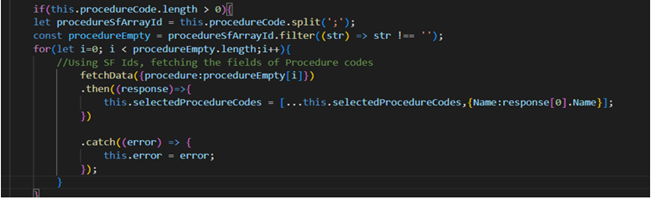
In the above code Initially selectedProcedureCodes is an empty array. We are using the spread operator because each time for loop runs the new value of the response [0].Name can override the pervious value. Using the Spread operator can resolve this.
The spread operator is a powerful tool that simplifies array manipulation, concatenation, and function arguments in JavaScript. By taking advantage of its features, you can collect cleaner and more meaningful data while increasing your productivity. Once you understand the various uses of the spread operator, you will be able to benefit from it and improve your JavaScript programming skills.
Get Started
Share a few details about your goals: a Mirketa consultant will follow up within one business day.
 Certified Partner
 SOC 2 Certified
 HIPAA Ready
 Enterprise Ready