Agentic AI Security: Tool Poisoning and Audit Trails
Explore agentic AI security risks, including MCP tool poisoning, and learn how governance, permissions, approvals, and audit trails reduce exposure.
Sales teams today face an ever-evolving landscape filled with challenges that demand agility, efficiency, and precision. From managing complex pricing structures to navigating recurring revenue complexities, these obstacles can disrupt growth and impact the bottom line. Fortunately, Salesforce Revenue Cloud, backed by the expertise of leading Salesforce consulting partners, is a game-changer designed to tackle these issues while streamlining sales processes and driving consistent revenue.
In this blog, we’ll explore the top five sales challenges businesses encounter and how Salesforce Revenue Cloud, integrated with services like Salesforce Analytics Cloud and supported by Salesforce implementation companies, can address them.
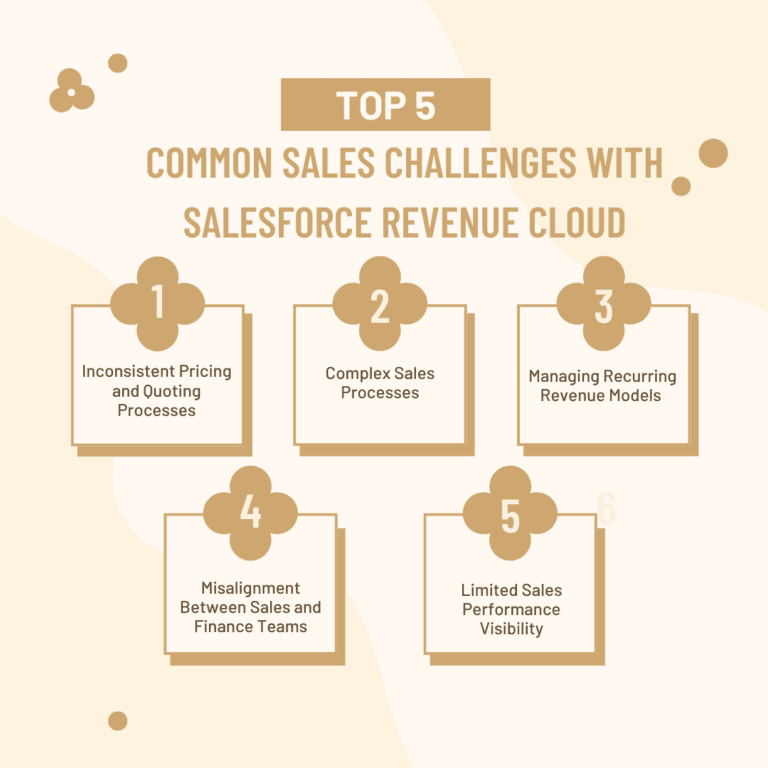
The foundation of a successful sales cycle lies in accurate pricing and quoting. However, many organizations struggle with inconsistent pricing structures and time-consuming manual quote creation, which often leads to errors and lost deals.
The Challenge:
How Salesforce Revenue Cloud Addresses This:
With its Configure, Price, Quote (CPQ) functionality, Salesforce Revenue Cloud standardizes the pricing and quoting process. Salesforce managed services ensure these processes remain efficient over time.
By combining CPQ with Salesforce custom application development, businesses can further tailor pricing models to their unique needs.
In many organizations, sales processes are overly complicated, involving multiple touchpoints and lengthy approval chains. These inefficiencies slow down sales cycles and frustrate teams.
The Challenge:
How Salesforce Revenue Cloud Simplifies Sales:
Salesforce Revenue Cloud unifies and streamlines processes, integrating seamlessly with tools like Salesforce Service Cloud implementation to connect sales and service workflows.
Subscription-based and usage-based pricing models are on the rise, making recurring revenue management a critical challenge for businesses.
The Challenge:
How Salesforce Revenue Cloud Excels:
Salesforce Revenue Cloud simplifies recurring revenue processes with automation and flexibility, supported by Salesforce data migration for accurate records.
Teams in charge of sales and finance frequently operate independently, which causes misunderstandings and income leaks.
The Challenge:
How Salesforce Revenue Cloud Bridges the Gap:
Salesforce Revenue Cloud integrates sales and financial processes, enhancing collaboration with tools like Salesforce Finance Cloud and Salesforce Service Cloud integration.
Organizations can further enhance alignment by leveraging Salesforce admin services for continuous support.
Without clear insights into metrics, sales leaders struggle to identify bottlenecks or forecast revenue accurately.
The Challenge:
How Salesforce Revenue Cloud Boosts Visibility:
For actionable insights, Salesforce Revenue Cloud combines Einstein AI with Salesforce Analytics Cloud.
Adopting Salesforce Revenue Cloud, alongside services like Salesforce consulting services and Salesforce app development, offers transformative benefits
Best Practices for Implementation
To maximize the benefits of Salesforce Revenue Cloud, follow these steps:
Sales challenges are inevitable, but they don’t have to hold your organization back. With tools like Salesforce Revenue Cloud and the support of expert Salesforce consulting partners, businesses can overcome obstacles, streamline operations, and deliver exceptional customer experiences.
If you’re ready to take your sales strategy to the next level, now is the time to explore Salesforce Revenue Cloud’s transformative power.
Get Started
Share a few details about your goals: a Mirketa consultant will follow up within one business day.
 Certified Partner
 SOC 2 Certified
 HIPAA Ready
 Enterprise Ready